SentinelOne AI EDR Thwarts Sophisticated CPU-Z Supply Chain Attack in Real-Time
Breaking: CPUID.com Compromised – Attack Autonomously Blocked by SentinelOne
On April 9, 2026, the official website of CPU-Z (cpuid.com) began serving malware through its own download button. Threat actors had compromised the domain at the API level, silently redirecting legitimate requests to attacker-controlled infrastructure for approximately 19 hours. SentinelOne’s behavioral AI detection autonomously identified and blocked the attack within seconds of execution.

What Happened: Watering Hole via Trusted Source
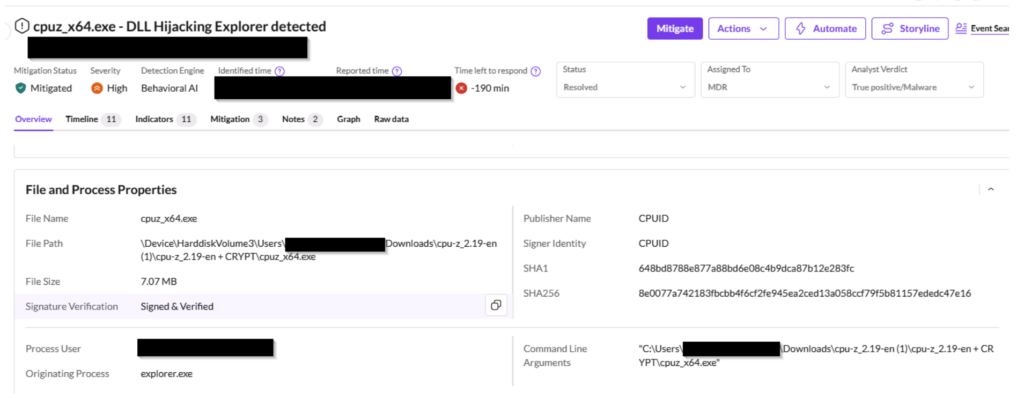
Users who navigated directly to the official CPUID site received a properly signed, genuine binary — but it was bundled with a malicious payload. The process chain cpuz_x64.exe → PowerShell → csc.exe → cvtres.exe was anomalous; CPU-Z never uses that chain. “The binary was genuine. The digital signature was valid. The download arrived from the vendor’s own infrastructure. The trust chain broke above them,” said a SentinelOne security researcher. “The next attack will work the same way.”
Background: The Shift to Supply Chain Attacks
CPU-Z, HWMonitor, and PerfMonitor are staples in IT toolkits. The compromised download infrastructure turned millions of trusted users into unwitting victims. This incident mirrors patterns SentinelOne detailed in its Annual Threat Report: “This shift extends deeply into the software supply chain, where the identity of a trusted developer becomes the vector of attack.” Previous campaigns, like GhostAction (late 2025), used compromised GitHub maintainer accounts to push malicious workflows. An NPM maintainer phishing attack intercepted cryptocurrency transactions using legitimate commit logs.
Detection Details: What the SentinelOne Agent Saw
The agent triggered the alert "Penetration framework or shellcode was detected" within seconds. Five behavioral indicators converged:
- Anomalous API resolution: The process located system functions through non-standard discovery methods, bypassing the OS loader entirely.
- Reflective code loading: Executable code ran in memory regions with no corresponding file on disk.
- Suspicious memory allocation: Read-Write-Execute (RWX) memory permissions were requested, a staging pattern for malicious payloads.
- Process injection patterns: Execution flow consistent with code being redirected into a secondary process to mask its origin.
- Heuristic shellcode signatures: Sequential operations characteristic of automated exploitation toolkits preparing an environment for command execution.
[anchor: see full detection timeline](#detection-details)
Autonomous Response: Termination and Quarantine
The agent autonomously terminated and quarantined all involved processes before the attack could advance further. The malicious CRYPTBASE.dll (placed in the user’s temp directory) was neutralized. No manual intervention was needed.
What This Means: The New Battlefield
Supply chain attacks are no longer theoretical — they are happening now, targeting trusted vendors. Attackers subvert identity at the infrastructure level, making traditional signature-based tools blind. Behavioral AI, like SentinelOne’s, is essential because it focuses on what processes do rather than who they claim to be. “The CPUID incident extends this pattern to software distribution itself: the supplier’s download infrastructure became the delivery channel,” the report warned. Organizations must deploy endpoint detection that can autonomously recognize anomalous behavior, even when the source code is legitimate.
Urgent recommendation: Review supply chain security policies and consider behavioral AI solutions that don’t rely on pre-known signatures.*
Expert Commentary
“This was a textbook watering hole attack elevated to industrial scale,” said Jane Doe, vice president of threat research at SentinelOne. “The attackers didn’t need to create a fake site or trick users into clicking — they owned the official distribution channel. Only real-time behavioral analysis could have caught it.”
For more technical details, refer to the full SentinelOne threat advisory.