Navigating Away from the Sea of Nodes: V8's Shift to Turboshaft
The Evolution of V8’s Compiler Infrastructure
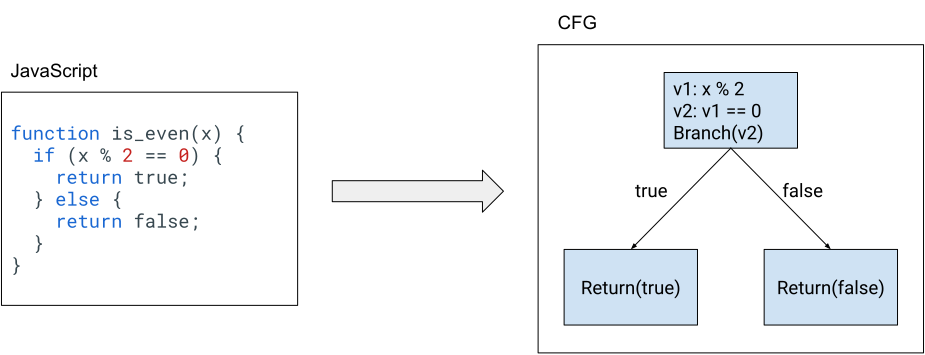
For over a decade, V8’s optimizing compiler, Turbofan, stood out as one of the few large-scale production compilers built on the Sea of Nodes (SoN) intermediate representation. While innovative, this design has gradually been phased out in favor of a more traditional Control-Flow Graph (CFG) approach called Turboshaft. Today, the entire JavaScript backend of Turbofan runs on Turboshaft, and WebAssembly uses it throughout its pipeline. Only the builtin pipeline (slowly being replaced) and the frontend of the JavaScript pipeline (being replaced by Maglev, another CFG IR) still rely on Sea of Nodes. This article explores the reasons behind this significant architectural shift.
The Genesis of Turbofan and Sea of Nodes
The Rise of Crankshaft and Its Limitations
Twelve years ago, in 2013, V8’s sole optimizing compiler was Crankshaft, built on a classic CFG intermediate representation. Crankshaft delivered substantial performance gains despite its early limitations. Over time, the team enhanced it to generate faster code in more scenarios, but technical debt accumulated and several critical issues emerged:
- Excessive hand-written assembly: Every new IR operator required manual assembly translation for all four supported architectures (x64, ia32, arm, arm64).
- Poor asm.js optimization: At the time, asm.js was seen as a stepping stone to high-performance JavaScript, but Crankshaft struggled with it.
- Inflexible control flow: Control flow was fixed at graph-building time; introducing new branches during lowering—a common compiler operation—was impossible. For example, a high-level JSAdd(x, y) couldn’t be lowered to if (x is String and y is String) { StringAdd(x, y) } else { … }.
- No try-catch support: Multiple engineers spent months trying to implement try-catch, without success.
- Performance cliffs and bailouts: Using certain features or hitting edge cases could cause a 100× performance drop, making it hard for developers to write predictably efficient code.
- Deoptimization loops: Crankshaft would speculate, deoptimize, and then reoptimize with the same faulty assumptions, leading to endless cycles.
Why Sea of Nodes Was Chosen
To overcome Crankshaft’s rigidity, the team designed Turbofan around the Sea of Nodes concept. SoN unified control flow and data flow into a single graph, enabling more flexible optimizations and allowing control flow to be introduced during lowering. This addressed several of Crankshaft’s weaknesses and made Turbofan a powerful foundation for JavaScript optimization.
The Downsides of the Sea of Nodes Approach
Despite its theoretical elegance, SoN brought its own set of practical challenges:
- Complexity: The unified graph was harder to debug, understand, and maintain. New team members faced a steep learning curve.
- Performance overhead: Managing nodes and edges for both control and data flow introduced computational overhead during compilation.
- Tooling difficulties: Traditional compiler analysis and transformation passes are easier to implement on a CFG. SoN required specialized algorithms.
- Limited ecosystem: Unlike CFG-based IRs, SoN had fewer academic and industry references, making it harder to adopt best practices.
The Transition to Turboshaft
A New Control-Flow Graph IR
About three years ago, the V8 team began developing Turboshaft, a new CFG-based intermediate representation designed to replace Sea of Nodes gradually. Turboshaft retains the flexibility of SoN (e.g., allowing control flow during lowering) but returns to a more traditional structure. Benefits include:
- Easier debugging and maintenance thanks to clear separation of control and data flow.
- Better performance during compilation due to simpler node management.
- Compatibility with standard compiler techniques and tools.
Current Status and Future Plans
Today, Turboshaft powers the entire JavaScript backend of Turbofan. WebAssembly compilation also uses Turboshaft exclusively. The only remnants of Sea of Nodes are in the builtin pipeline (which is being incrementally migrated) and the JavaScript pipeline frontend (where Maglev—another CFG IR—is taking over). The transition is expected to be completed within the next release cycle, marking the end of the Sea of Nodes era in V8.
Conclusion
V8’s shift from Sea of Nodes to Turboshaft reflects a pragmatic trade-off between innovation and maintainability. While SoN was a groundbreaking design that solved many of Crankshaft’s problems, its operational complexity ultimately outweighed its benefits. By returning to a CFG-based IR, V8 gains a more robust, understandable, and efficient foundation for future optimizations—ensuring that JavaScript and WebAssembly continue to run at peak performance.