10 Stunning Revelations About the James Webb Telescope's Mysterious 'Little Red Dots'
The James Webb Space Telescope (JWST) has unveiled a universe of enigmas, but few are as baffling as the peculiar 'little red dots' scattered across deep-space images. Initially dismissed as distant galaxies, these objects have sparked intense debate. Now, fresh X-ray data hints at a radical explanation: they might be 'black hole stars'—hypothetical cosmic hybrids that challenge our understanding of stellar evolution. Dive into this listicle to uncover the truth behind these crimson anomalies.
1. The Discovery of the Little Red Dots
In its first treasure trove of images, JWST pinpointed numerous tiny red specks in the early universe, dating back to just a few hundred million years after the Big Bang. These dots are surprisingly compact and emit intense infrared light, unlike anything seen before. Astronomers dubbed them 'little red dots' due to their distinct color and small size, sparking a cosmic whodunit.
2. Why They Appear Red
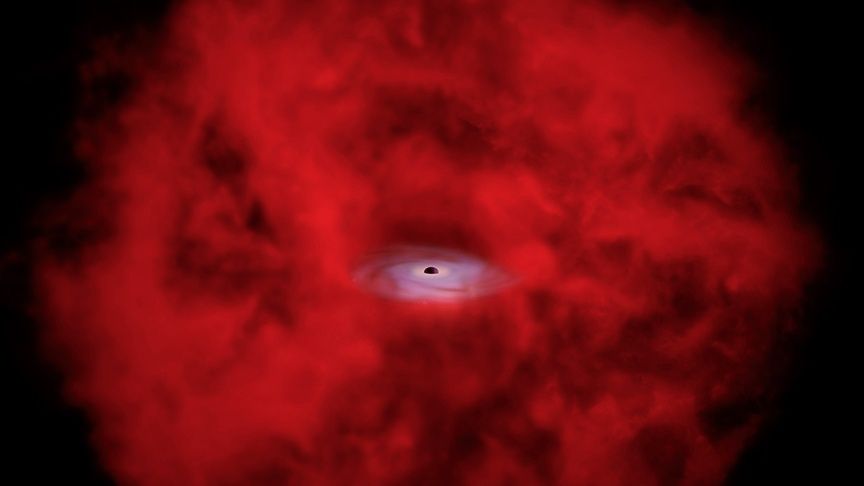
The redness of these dots isn't just cosmetic—it's a clue. Their redshift suggests extreme distance and age, but the specific hue indicates they are mostly emitting light at longer wavelengths. This could mean they are shrouded in dust or consist of old, cool stars. However, their brightness contradicts typical old-star populations, leading to alternative theories.
3. The Initial Hypotheses: Galaxies or Black Holes?
Scientists first proposed two mainstream ideas: either these are fledgling galaxies bursting with star formation, or they host actively feeding supermassive black holes (quasars). Both scenarios have problems. Galaxies this early shouldn't shine so steadily, while black holes would produce X-rays—which were initially missing.
4. X-Ray Observations Finally Arrive
Recent observations using the Chandra X-ray Observatory have detected faint X-rays emanating from one of these red dots. This is a game-changer. X-rays are the hallmark of high-energy processes near black holes. The detection suggests that at least some of these dots are not ordinary galaxies but something far more exotic.
5. Enter the Black Hole Star Hypothesis
Intriguingly, the X-ray signature is weaker than expected from a typical quasar. This aligns with the 'black hole star' model—theoretical objects where a small black hole sits at the center of a massive star, sustained by accretion. Such stars would emit a steady glow with muted X-rays, perfectly matching the data.
6. What Exactly Is a Black Hole Star?
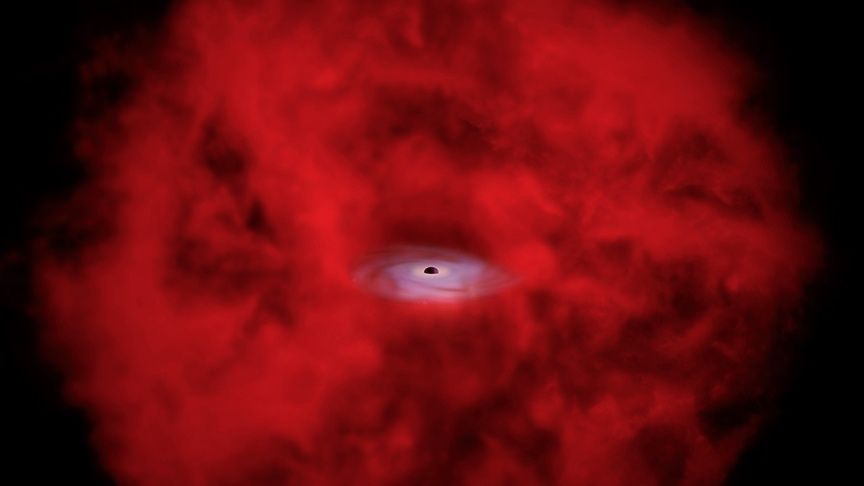
Black hole stars are a exotic concept from the 1960s, revived by modern simulations. They would form when a large gas cloud collapses directly into a black hole while still being surrounded by a dense envelope of star stuff. The black hole feeds on the envelope, preventing it from collapsing further, creating a stable 'quasi-star' that can shine for millions of years.
7. Why They Would Appear as Red Dots
Black hole stars are immense—up to tens of thousands of solar masses. Their outer layers are cool and puffy, emitting mostly infrared light like a red giant. This accounts for the red color seen by JWST. Meanwhile, the inner black hole releases energy, but most X-rays are absorbed by the thick envelope, only leaking a faint signal like that detected.
8. Implications for Galaxy Formation
If confirmed, black hole stars would revolutionize cosmology. They could serve as seeds for supermassive black holes that later grow into quasars and reside at galaxy centers. This bridges a gap in our models of early universe structure formation, explaining how such massive black holes appeared so quickly after the Big Bang.
9. The Need for More Data
One detection is not enough. Astronomers are now scanning for more little red dots with X-ray telescopes like Chandra and future missions such as the Advanced Telescope for High Energy Astrophysics (ATHENA). Simultaneously, JWST continues to take high-resolution spectra to identify characteristic emission lines that would confirm the black hole star scenario.
10. What This Means for Our Cosmic Story
Whether these dots are black hole stars, supermassive black holes, or something else entirely, they force us to rethink how the first objects in the universe formed. Each new observation peels back a layer of mystery, inching us closer to understanding the dawn of cosmic time. The little red dots may be tiny, but they carry colossal questions.
In conclusion, the James Webb Space Telescope's little red dots are more than a curiosity—they are a window into the universe's infancy. The X-ray data suggesting black hole stars is just the beginning. As telescopes refine their gaze, we may soon have a definitive answer to what these strange objects truly are. Stay tuned—the cosmos is never done revealing its secrets.